

What is "frequency response curve"
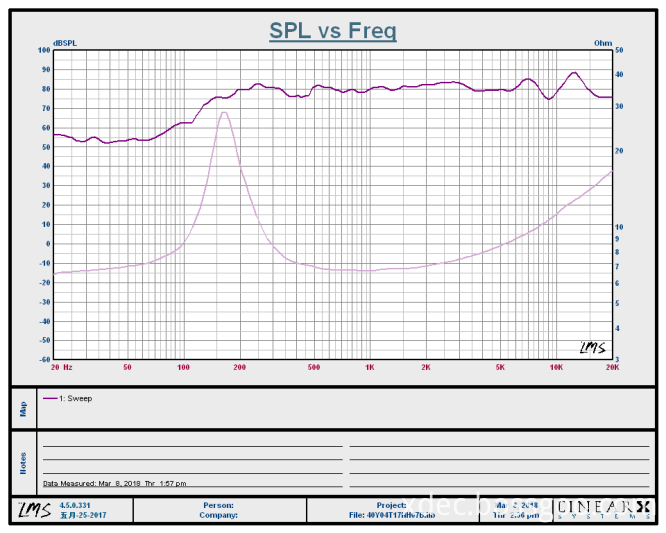
"Frequency response curve" decomposition: "frequency" refers to "frequency", which is the same as "tone" in sound performance; "response" can be regarded as the speaker system (mechanical and electrical) converting the "frequency" of the input electrical signal into Sound energy response. And this response, received by the microphone and calculated by the test instrument, is presented in the form of dB SPL logarithmic value. When a lot of "frequency" response values are connected together, it becomes a "curve" with peaks and valleys. This kind of curve is called frequency response curve, or frequency response curve for short.
Speaker and frequency response curve
Is the frequency response curve of the audio system or speaker products required to be straight? Many people argue on this issue, and the focus of the argument is often that what sounds good is not necessarily straight, and what is straight may not sound good.
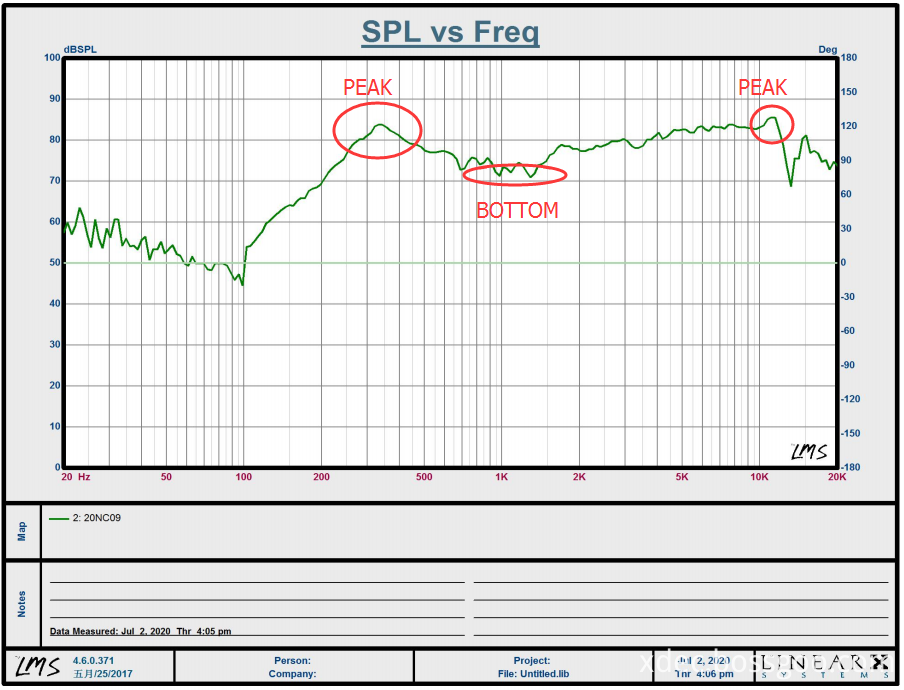
For example, the curve of a speaker near 80 Hz is more prominent, it means that this speaker is too expressive for the frequency band near 80 Hz. If you play music, then the bass sound will feel heavy. Or the curve of a certain speaker has a depression near 1000 Hz, which means that the speaker has a weak expressive power for the frequency band near 1000 Hz, and the output sound pressure of the frequency band near 1000 Hz in the input signal is reduced. The sound is not what it used to be.
The flatness of the frequency response curve actually tells you the difference in the amount of gain of this speaker or audio system for the sound signals of different frequency bands. The flatter the curve is, the closer the gain of each frequency band of the speaker or sound system is to the same. However, the sound box or system does not equate the input signal with the same gain in each frequency band and whether it sounds good or not. why? Because the same gain amount only expresses the same amount of amplifying the sound of each frequency band in the input signal. For example, the gain amount of a certain system for each frequency in the full audio is 30 decibels. If you make a sound of 1000 Hz, the sound pressure level is At 80 decibels, the sound pressure level of the 1000 Hz sound emitted by the speaker is 80+30=110 decibels. The sound pressure level of the 2000 Hz sound you make is 60 decibels, so the sound pressure level of the 2000 Hz sound played by the speaker is 90 decibels. When it is not amplified by the system, the sound pressure level of your 1000 Hz sound and 2000 Hz sound differs by 20 decibels. Then through this system with the same gain for each frequency band, the sound pressure level of the 1000 Hz sound and the 2000 Hz sound emitted by the speaker is also 20 decibels different, and the formation remains unchanged, ha ha. However, if the gain of your system for 1000 Hz is too large (highlighted on the curve), it is not 30 decibels but 40 decibels, and the gain for 2000 Hz is too low (the curve is concave), not 30 decibels but It is 20 decibels. Then your original sound of 80 decibels with a sound pressure level of 1000 Hz, after passing through the system, made a sound of 120 decibels, while the original sound of 60 decibels and 2000 Hz that you made, after passing through the system, it made a sound of 80 decibels. sound. The difference in sound pressure level between 1000 Hz and 2000 Hz before passing through the system is 20 decibels. After passing through the system, the difference in sound pressure level between 1000 Hz and 2000 Hz becomes 40 decibels. This is not the original difference. The team has changed. , This is also a kind of distortion. Therefore, whether the frequency response curve is straight or not, only represents whether a certain speaker or a certain system has roughly the same volume performance for the sound of each frequency band, and has nothing to do with the sound quality.
As for whether it sounds good or not, first of all, your system should have roughly the same gain for the input signal in each frequency band (that is, the curve should be as straight as possible), so that the ratio of the sound size of each frequency band in the original signal can be amplified and restored. , At least what should be strong must be strong, and what should not be strong must be weak. It is a good foundation to be able to truly reflect the strength of the sound. To be nice, it is more important to make a fuss about sound quality. The sound quality is bad, and even the best system shows bad sound. If you don`t believe me, you can get a loud speaker, use dozens of MP3 input to the mixer, and turn on the mixer input gain to the end, and play it from the Internet. Download the music in MP3 format and try to listen to the sound. The sound quality is something inherent, not just a question of straightness. The curve is straight, just expressing the system's restoration of the volume. Then the restoration of sound quality is probably ideal. For example, it is almost impossible for people to use Steinway pianos to record piano music with DPA microphones. It is almost impossible to completely restore the texture through audio. It's like listening to someone playing a violin next to you, just like listening to a violin song played by the same person next to a speaker. Even if you use the best speakers, it will always sound different. This involves the issue of sound quality reduction degree and sound field reduction degree, and these reduction degrees are not to say who can be expressed by curves. The level of sound quality has a lot to do with your materials, your craftsmanship, the designer's technique and artistic accomplishment. Can a master's work of art carved with white jade look the same as a street artisan's cast of plaster?
Conversely speaking, the curve is straight, which means that the system or device has a high degree of restoration of the volume of each frequency band in the input signal. As a sound, this is only a basic indicator, but it is also a very important indicator. For example, a sound system with good volume reduction, the input source signal itself is high, medium and low, etc. The volume ratio of each voice is harmonious (for example, a master-level music recorded by a recording master, like a feverish sky disc.), through a speaker It naturally feels harmonious when restored. If the input signal is a song sung by a karaoke-level singer who can only scream and scream, the high and middle bass would be inharmonious originally, and it would naturally be inharmonious when coming out of a high-reduction audio system. However, systems with poor reproducibility, such as the frequency response curve protruding at low frequencies, and the mid-to-high frequencies are a bit concave, may make the bass that is not very strong, weaken the trumpet that should be strong, and play the original Works with harmonious volumes of all voices may become discordant. However, if it happens to happen that the musician has played the strong bass sound weaker, or the weak trumpet sound has been blown strong, the negative negative becomes positive, and the original volume is not harmonious. This low-reduction speaker may actually be more harmonious and beautiful than a higher-reduction speaker.
In addition, for audio products, not only speakers, but also power amplifiers, mixers and other peripherals have frequency response curves. According to industry standards, these devices are required to have a flat frequency response curve without adjustments. The purpose is to require these devices to maintain as faithful as possible the sound volume in the characteristics of the signal. If the equalizer you use, without adjustment and the faders are leveled, the frequency response curve is higher at 80 Hz and lower at 1000 Hz, would you still want it?
BTW, XDEC think a good speaker frequency respond curve need t be as flat as possible,
they are passive parts, we need speaker can replay the sound as the source audio file,
then can reflect the original sound, that is call a good speaker respond curve