

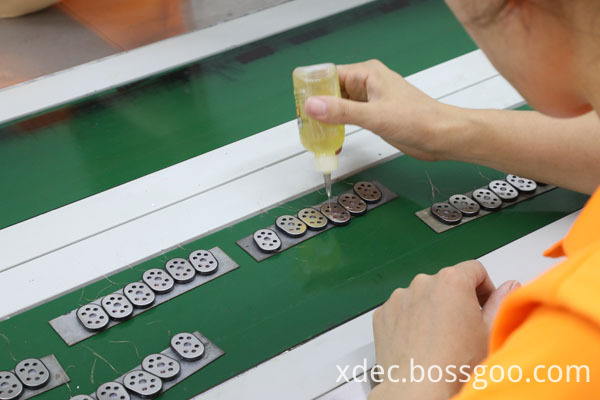
Application According to the internal relationship between the selection of adhesives in different parts of the functional loudspeaker, as well as the special application of various adhesives in the loudspeaker, reasonable selection can bring twice the result with half the effort.The application of adhesive with different characteristics in different parts of loudspeaker has different effects on sound quality. And simply compare the advantages of using different types of adhesives in the current central adhesive position.Provide technical reference on adhesive for speaker designers.
First, the role of adhesive
A. Types and functions of adhesives
Adhesive curing can be divided into heat curing, UV curing, wet curing, heat-UV curing and cationic curing; According to the chemical properties gram is divided into epoxy, polyurethane, silicone, acrylic acid and other types;According to curing properties, it is divided into three categories: thermocuring, thermoplasticizing and elastomer.
Two, according to the role of classification
A, structure type: with high mechanical strength, used for the two materials together forever nine, and strong bearing capacity, the hardness of A ingot in the curing state.
B, non-structural: with the mechanical strength of one ingot, used to temporarily connect objects with small load requirements, non-structural adhesives are also hard in the cured state.
C, thermosetting type: crosslinked polymer formed by chemical reaction curing, curing after heating will not soften, can not be re-bonded.
Thermosetting: Thermosetting adhesives are crosslinked polymers cured by chemical reactions and will not be softened by reheating after curing.
Thermoplastic: Thermoplastic adhesives do not form crosslinked polymers like thermoset, so they can be re-softened and re-bonded. He is a single component system, hardening by high temperature cooling, or hardening by evaporation of solvent.
Elastic: Elastic adhesives have high elongation and can be made from synthetic or natural polymer solvents in the form of latex.
Synthetic: synthetic adhesive is made up of thermoset, thermoplastic, and elastic adhesive. It takes advantage of the advantages of each material, so it has better comprehensive performance.